 Ask AI
- Get Started
- Image & Video APIs overview
- AI Power Start
- SDK Quick Starts
- Developer Kickstart
- AI agents
- Try it!
- VS Code Extension
- Video tutorial library
- Programmatic asset management
- Image onboarding
- Programmatic upload
- Upload programmatically
- Upload with Fetch API
- Create upload presets (Node.js)
- Create upload presets (Console UI)
- Auto upload
- Moderate images with AI
- Use AI to generate image captions
- Upload images in Flutter
- Upload images in Node.js
- Auto-tag images in Node.js
- Upload multiple files in Node.js
- Upload videos in Node.js
- Upload images in Python
- Auto-tag images in Python
- Upload videos in Python
- Upload images in PHP
- Upload images in Go
- Upload assets in a React app
- Upload assets in a Vue.js app
- Drag-and-drop uploads in React
- Upload assets in a Next.js app
- Upload assets with Server Actions
- Upload assets in Svelte
- Upload assets in a SvelteKit app
- Upload assets in a Remix app
- Upload images in Astro
- Upload images in Hono
- Use webhooks to remove backgrounds
- Upload images in Laravel
- Interaction with Cloudinary APIs
- Cloudinary SDKs
- Find your credentials
- Configure the JavaScript SDK
- Configure the React SDK
- Configure the Angular SDK
- Configure the Flutter SDK
- Configure Svelte Cloudinary
- Configure the Javascript SDK in Svelte
- Getting started with Cloudinary in Node.js
- Configure the Node.js SDK
- Configure the Python SDK
- Configure the PHP SDK
- Install and configure Laravel SDK
- Configure the Go SDK
- Configure the Vue.js SDK
- Configure the Next.js SDK
- List images in Next.js
- Lazy load images with Next.js
- Add images to Sanity with Next.js
- Image fallbacks in JavaScript
- Captioning on upload with Node.js
- Create PDFs from images in Node.js
- Delete assets with Node.js
- Manage images in a Django app
- Image gallery with Astro
- Cloudinary CLI
- Widgets and tools
- Optimization and delivery
- Transformations
- Get started with transformations
- Advanced transformation features
- Text overlay transformations
- Add watermarks in JavaScript
- Complex transformations
- Named transformations
- Advanced image components
- Trim videos in Node.js
- Splice videos in Node.js
- Zoompan effect
- Video transformations
- Crop and resize images in React
- Crop and resize videos in React
- Crop and resize images in Python
- Crop images in PHP
- Remove backgrounds and add drop shadows
- AI generative fill in Next.js
- Color accessibility in JavaScript
- Transformations for social media
- Dev Hints on YouTube
- Dev Hints en Español
- Cloudinary Café Training Sessions
- Programmatic asset management
- Additional onboarding resources
- Guides
- Cloudinary Image
- Product overview
- Image transformations
- Image transformations overview
- Named transformations
- Transformation rollout
- Image format support
- Delivery types and flags
- Transformation types
- Resizing and cropping
- Placing layers on images
- Effects and enhancements
- Background removal
- Generative AI transformations
- Face-detection based transformations
- Advanced image transformations
- Image optimization and delivery
- Programmatic image creation
- Product Gallery widget
- Media Editor widget
- Image add-ons
- Troubleshooting and tips
- Troubleshooting image transformation errors
- 40x errors and X-Cld-Error messages
- Add a solid color overlay
- Images delivered without gzip compression
- Long time to first byte (TTFB) on WebPageTest.org
- Update a named transformation
- Cloudinary vs Imagga cropping
- Placeholder images (LQIP)
- How to detect corrupted images
- Force specific image when sharing links on Facebook
- Blurry images
- Offset face-detection gravity
- Cloudinary Video
- Product overview
- Cloudinary Video Player
- Video Player features
- When to use the video player
- Installation and setup
- How to embed the Video Player
- Video Player Studio
- Video Player customization
- Playlists and recommendations
- HLS and MPEG-DASH
- Video Player accessibility
- Video Player advanced features
- Video Player API reference
- Player profiles API reference
- Video config API reference
- Adaptive bitrate streaming
- Video transformations
- Video and audio optimization
- Video transcription
- AI Video Analysis
- AI Video Analysis API reference
- Video analytics
- Live streaming
- Video add-ons
- Video best practices
- Social media videos
- Troubleshooting and tips
- Upload
- Asset management
- CRUD asset management APIs
- Media Library for developers
- Search for assets
- Eager and incoming transformations
- Custom metadata
- Analyze assets
- Moderate assets
- Webhook notifications
- Advanced asset management
- Add-ons
- Troubleshooting and tips
- Admin API authentication issues
- Why has the public ID of my asset changed?
- Asset ID vs public ID
- Check resource type and delivery type
- Get image or video dimensions
- Download account assets
- Delete or modify original images
- Does Cloudinary store any cookies?
- Underscores in public IDs or folder names
- Update already fetched asset
- Upload, manage, and deliver PDFs
- Cloudinary "sample" images
- Avoiding duplicate uploads
- Permitted naming conventions
- Adult/NSFW content policy
- High transformation rate
- Account management
- Retail and e-commerce
- User-generated content
- Accessible media
- AI in action
- Native mobile
- Add-ons
- Advanced Facial Attributes Detection
- Amazon Rekognition AI Moderation
- Amazon Rekognition Video Moderation
- Amazon Rekognition Auto Tagging
- Amazon Rekognition Celebrity Detection
- Aspose Document Conversion
- Cloudinary AI Background Removal
- Cloudinary AI Content Analysis
- Cloudinary AI Vision
- Cloudinary Duplicate Image Detection
- Cloudinary Image Generation
- Google AI Video Moderation
- Google AI Video Transcription
- Google Auto Tagging
- Google Automatic Video Tagging
- Google Translation
- Image to Video
- Image to Video API reference
- Imagga Auto Tagging
- Imagga Crop and Scale
- Perception Point Malware Detection
- Microsoft Azure Video Indexer
- OCR Text Detection and Extraction
- Pixelz - Remove the Background
- URL2PNG Website Screenshots
- VIESUS™ Automatic Image Enhancement
- WebPurify Image Moderation
- Cloudinary Image
- References
- Transformation URL API
- Upload API
- Admin API
- Provisioning API
- Claimable Cloud API
- Agent account creation API
- Permissions API
- Analyze API (Beta)
- Live streaming API
- Player profiles API
- Video config API
- Video Canvas API
- Image Generation API
- Image to Video API
- AI Video Analysis API
- Cloudinary CLI
- SDK references
- Postman collections
- Upload Widget API
- Product Gallery API
- Media Editor API
- Video Player API
- Media Library Widget API
- SDKs
- Release Notes
Roles and Permissions via API
Get Started with Cloudinary
Paste one prompt into your AI coding assistant and it sets up Cloudinary for you: installs the SDK, configures skills and MCP servers, and validates your setup.
Install Cloudinary Agent Skills
Cloudinary agent skills give your AI coding assistant first-class context for working with Cloudinary.
Run to install or update the skills:
View the Skills repo on GitHub | Learn about Cloudinary Skills
Last updated: Sep-16-2026
This guide describes the Roles and Permissions system. For details on all roles available in the legacy system, see Role-based permissions.
- Free and self-serve paid accounts: All free and self-serve paid accounts have been migrated to the new Roles and Permissions system.
- Enterprise accounts: Enterprise rollout has begun. If your team hasn't already been moved with Cloudinary's help, you're still on the legacy system.
You can confirm which permissions system you have. Open Console Settings and look for Role Management. If it's listed, your account is on Roles and Permissions. If it isn't listed, you're still on the legacy permissions model.
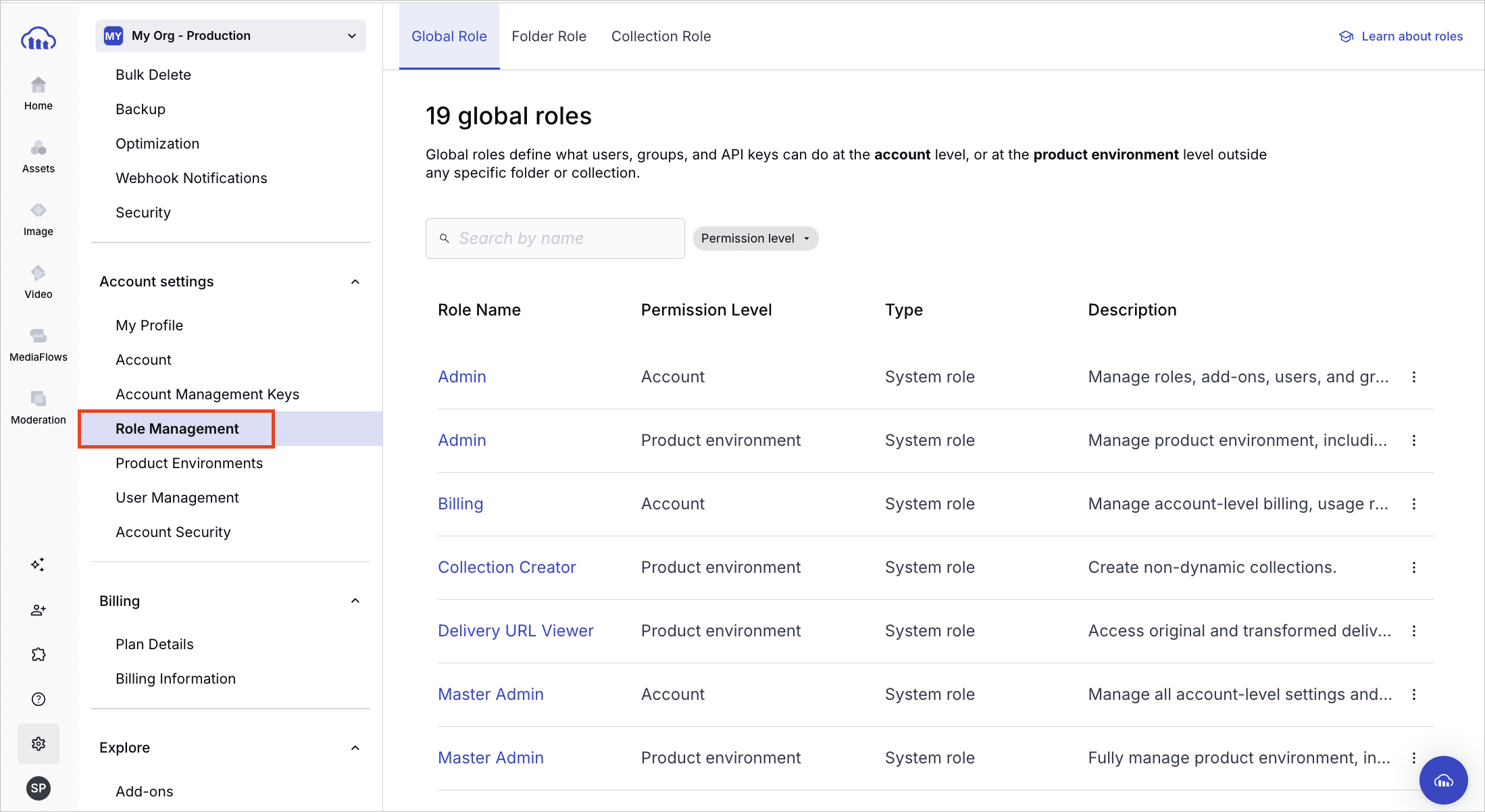
- For a quick comparison, see Roles and Permissions vs. legacy.
- If your account is being migrated, see Migrating to Roles and Permissions to understand what changes.
Overview
Use the Permissions API to programmatically manage access control across your Cloudinary account. The API allows you to create and assign roles and define custom permission policies.
This section covers:
Manage roles: How to manage roles via the Permissions API, including viewing, creating, updating, and assigning roles
Assign roles: How to assign roles to principals (users, groups, and API keys), scoped to the account or specific product environments, via the Permissions API
-
Define custom policies: How to define and apply custom permission policies using the Cedar-based schema
NoteCustom policies give you fine-grained control, but they can behave in unexpected ways if not configured correctly. Review them carefully and test to make sure they align with your intended access rules.
On the Free plan and on self-serve paid plans, you can:
- Manage and assign system roles on the Role Management page of the Console Settings.
- Assign folder roles to API keys and other principals programmatically via the Admin API.
✔️ Feedback sent!
Error
Unfortunately there's been an error sending your feedback.
Rate this page:
